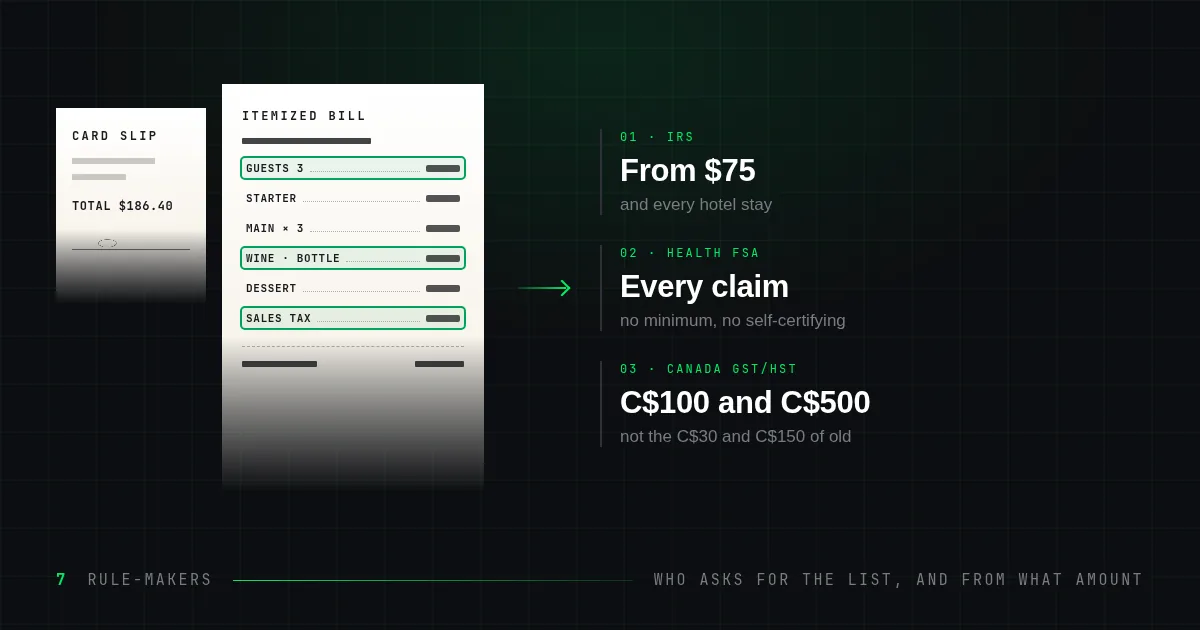
Itemized receipt: what it is and how to get one
An itemized receipt lists each item and its price. Who demands one (employers, the IRS, FSAs, HMRC, the CRA), the thresholds, and how to get one after the fact.
The dinner went well. Two clients, three courses, one bottle of wine, and a bill of $186.40 with the tip. You signed the card slip, folded it into your wallet and uploaded it with your expense report the next morning.
On Wednesday it came back: Itemized receipt required.
The same week, at home, a $48 pharmacy run bounced off your health FSA with almost the same words. Two different reviewers, two different rules, and the same complaint: the slip shows what you paid, but not what you bought.
An itemized receipt is the list behind the total. It names each item or service, gives each one its own price, and then shows the tax, the total and how you paid. A card slip only shows the total. Reviewers ask for the list because their question is usually about one line on it: the wine, the number of people, whether a pharmacy item was medical, or how much of the total was tax.
You get one from whoever sold you the thing. At a restaurant, ask for the itemized bill before you pay, and keep it with the signed slip. A hotel's is the folio. A doctor's is the itemized statement, and if Medicare paid any of it, federal law gives you a right to one.
We read the rules on 23 November 2026: the IRS, the federal travel rules, the FSA regulations, the UK and Canadian tax authorities, Medicare law and five university expense policies. Every rule below is quoted from its source.
This article is general information, not tax, legal or accounting advice. Your employer's policy and your FSA plan's rules can be stricter than the law. Check them before you rely on a threshold given here.
The short version
- An itemized receipt lists each item with its price. Then the tax, the total and the payment. A card slip shows the total only.
- Reviewers want it to check one line. Alcohol, personal items, the number of diners, whether an item is FSA-eligible, or the tax charged.
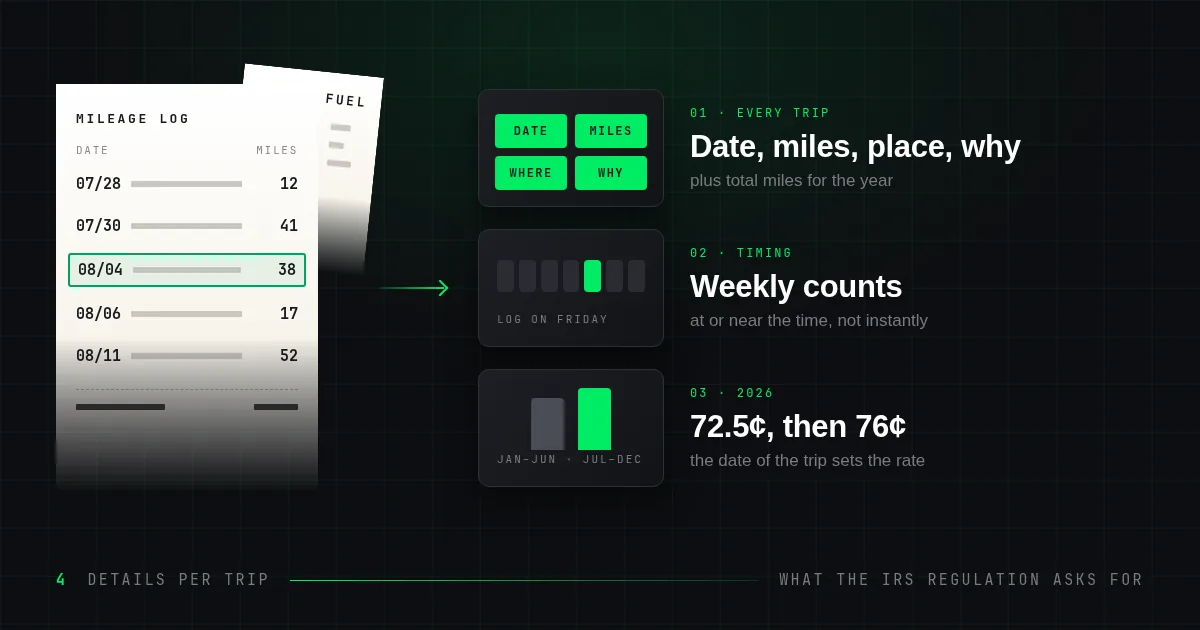
- The IRS doesn't always need one. It waives receipts for business expenses under $75, except lodging. A meal receipt still has to show the restaurant, the number of people, the date and the amount.
- Your FSA always needs one. Every claim must be backed by a third party's record of the item, the date and the amount. There's no small-claim exemption, and your own note doesn't count.
- Medicare patients can demand one. A provider has 30 days to send an itemized statement once you ask in writing.
- Canada raised its thresholds. Many guides still say C$30 and C$150. The law has said C$100 and C$500 since April 2021.
What is an itemized receipt?
An itemized receipt, spelled itemised in British English, is a receipt that breaks the purchase into its parts. Each line shows one item or service and what it cost. Under the lines come the subtotal, the tax, any tip or service charge, the total and the payment method.
The difference from a card slip is easiest to see side by side. Here's what our dinner looks like on each.
| On the card slip | On the itemized receipt |
|---|---|
| Restaurant name and address | Restaurant name and address |
| Date and time | Date, time, table and server |
| — | Number of guests: 3 |
| — | Each dish and drink, with its price |
| — | The bottle of wine, $58.00 |
| — | Subtotal and sales tax |
| Total before tip: $155.40 | Total before tip: $155.40 |
| Tip and total: $186.40, and your signature | — |
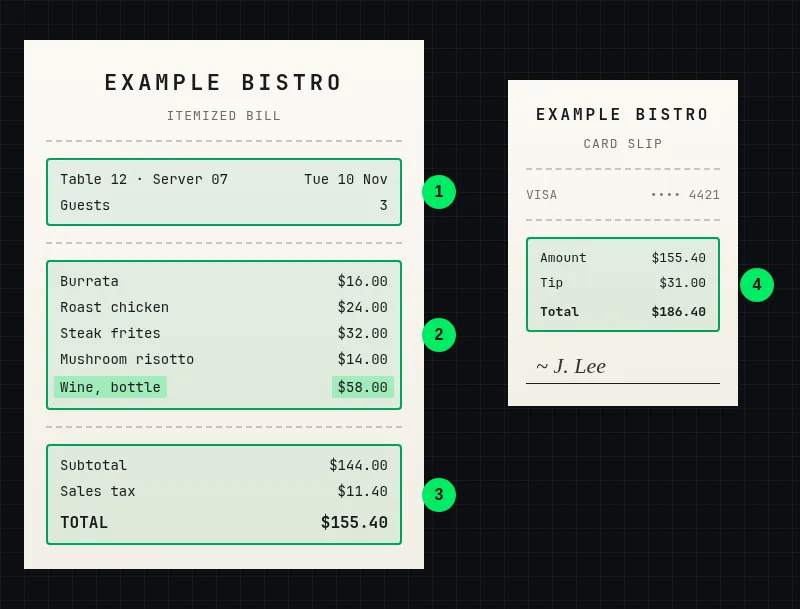
An illustrative restaurant bill, not a real restaurant's. 1, the number of guests. 2, each item with its own price, the wine included. 3, the subtotal, tax and total. 4, on the card slip, the tip and the total actually charged.
Neither one is complete on its own. The itemized receipt has the detail but not the tip. The card slip has the tip but not the detail. That's why many employers want both, which we come back to below.
Why isn't a card slip enough?
Because the reviewer's question is about what you bought, and a card slip can't answer it. Each kind of reviewer has its own question.
Your employer wants to know whether anything on the bill falls outside policy. Alcohol is the usual one. Purdue University says plainly: "Alcohol is not allowed on Sponsored or university funds." Without the list, the finance team can't tell whether the $58 bottle was on the bill, so it asks for the list. The University of Houston puts it this way: "non-itemized receipts such as credit card statements and receipts without a description of what was purchased will not be accepted."
The IRS wants the meal to be what you say it was. Publication 463 says a restaurant receipt is enough if it shows "The name and location of the restaurant", "The number of people served" and "The date and amount of the expense". It adds: "If a charge is made for items other than food and beverages, the receipt must show that this is the case."
Your FSA wants to know the item is medical. A $48 pharmacy charge could be prescriptions, or it could be shampoo. The rules require the receipt to describe "the service or product", so the plan can tell.
A tax authority reclaiming sales tax or VAT wants to see how much tax was charged, and by whom. A card slip doesn't say.
Who asks for an itemized receipt, and what do they want?
The rules differ more than most people expect. Some apply to every dollar, and some don't start until $75, £250 or C$100. We read each rule in its source and lined them up.
| Who's asking | When a receipt is needed | What it must show | Source |
|---|---|---|---|
| IRS, for a business deduction | $75 or more, and all lodging | Amount, date, place and essential character. For a meal, the number of people too | Publication 463 |
| Federal agencies, for employee travel | Lodging, and anything over $75 | Receipts plus an itemized list of expenses | 41 CFR 301-52.1 |
| Health FSA | Every claim, whatever the amount | The service or product, the date and the amount, from an independent third party | Proposed Treas. Reg. 1.125-6 and Publication 969 |
| HSA | No receipt sent, but you keep records | That each withdrawal paid a qualified medical expense | Publication 969 |
| HMRC, for UK VAT | When you need to reclaim VAT | £250 or less: a simplified invoice. Over £250: a full or modified VAT invoice | VAT Notice 700/21 |
| CRA, for Canadian GST/HST credits | Every claim, in three tiers | More detail at C$100, and a description of each supply at C$500 | SOR/91-45, section 3 |
| Medicare providers, for patients | When you ask in writing | Each item or service provided | 42 U.S.C. 1395b-7 |
Three things stand out.
The FSA rule is the strictest, by a long way. The proposed regulation that FSA plans follow says "All expenses must be substantiated", and that checking only claims "above a certain dollar amount, fails to comply". The third party "must provide information describing the service or product, the date of the service or sale, and the amount." And "Self-substantiation or self-certification of an expense by an employee does not satisfy the substantiation requirements". IRS Publication 969 says the same in fewer words: you must give the FSA "a written statement from an independent third party stating that the medical expense has been incurred and the amount of the expense."
The $75 lines aren't quite the same line. The IRS waives receipts where "Your expense, other than lodging, is less than $75." The federal travel rule asks for "Receipts for any lodging expenses and other expenses costing over $75". A $75.00 expense needs a receipt for the IRS but not for a federal travel claim.
The UK line is £250. HMRC lets a business issue a simplified invoice when the charge is "£250 or less (including VAT)". It must show the seller's name, address and VAT number, the time of supply, "a description which identifies the goods or services supplied", and the total with the VAT rate. Above £250, a business asked for a VAT invoice must issue "either a full VAT invoice or modified VAT invoice". Even the simplified version has to say what was sold.
Canada changed its numbers, and many guides haven't noticed
If you claim GST/HST input tax credits in Canada, the detail your receipt needs depends on its total. Several guides we found while researching this, from accounting firms and receipt apps alike, still give the tiers as under C$30, C$30 to C$149.99, and C$150 or more.
That's out of date. The regulations now set the tiers at "less than $100", "$100 or more and less than $500" and "$500 or more". The change came in a 2024 budget act, and section 142 of that act says the new amounts "are deemed to have come into force on April 20, 2021."
What each tier asks for, in the current text:
| Total on the receipt | What it must show |
|---|---|
| Under C$100 | The supplier's name, the date and the total paid |
| C$100 to C$499.99 | All of that, plus the supplier's GST/HST registration number, and either the tax charged or a statement that tax is included |
| C$500 or more | All of that, plus your name, the terms of payment and "a description of each supply sufficient to identify it" |
So a C$120 dinner now needs less on its receipt than the old guides say, and a C$400 one no longer needs your name on it.
How do you get an itemized receipt?
Ask whoever sold you the thing, and ask early. Most businesses can print or email the detailed version on the day. A week later it's still usually possible, but it takes a phone call.
At a restaurant
Ask for the itemized bill before you pay, and keep it. Then pay, add the tip and keep the signed card slip too. Iowa State University's rule for group meals shows why you want both: "Provide a combination of the itemized customer copy and paid copy." The itemized copy proves what was ordered. The paid copy proves the tip and the final amount.
If you only kept the slip, call the restaurant. Give the date, the time, the total and the last four digits of the card. Purdue tells its staff to do exactly this: "Contact that restaurant/vendor for a copy of the receipt."
At a hotel
The itemized receipt is the folio, the hotel's bill for the stay. Iowa State asks for "a final folio that shows room rates, taxes, fees, etc., and a $0 balance due that confirms payment". The University of Arkansas is blunter about what doesn't count: "A credit card receipt is not acceptable. Reservation confirmation notice is not acceptable documentation."
Our guide to getting a hotel receipt or folio covers where each chain keeps it, and who issues it when you booked through Expedia or Booking.com.
For flights, rental cars and rides
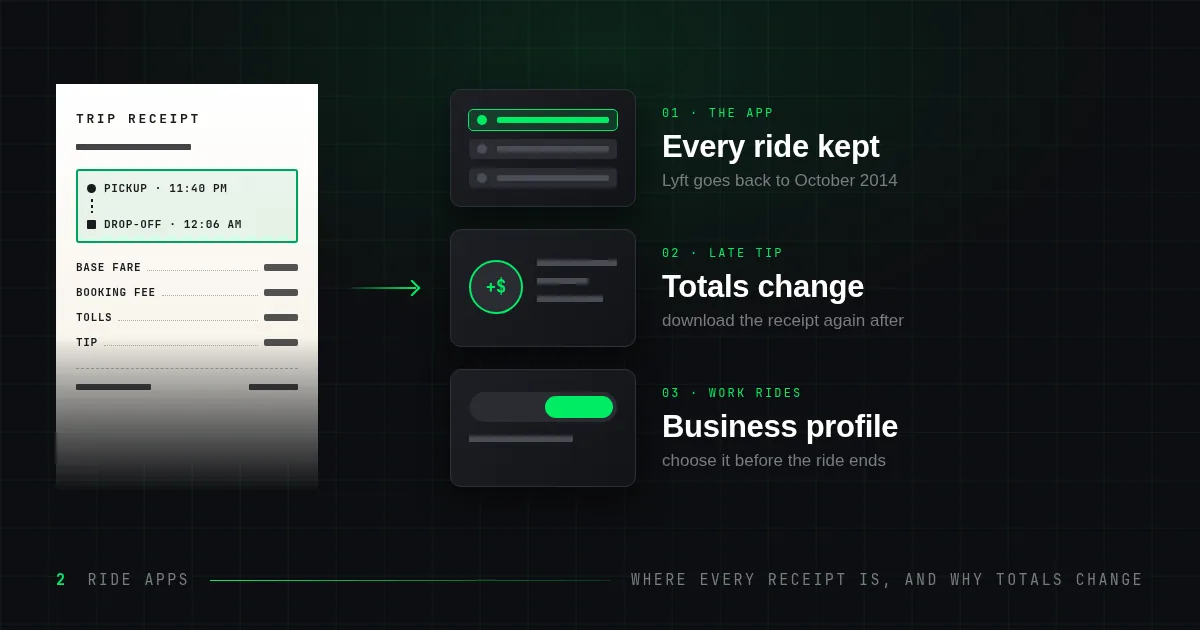
These usually come itemized already. An airline's e-ticket receipt lists the fare and each tax. A rental car's final receipt lists the days, the fees and the fuel. An Uber or Lyft receipt breaks the fare into its base rate, fees and tolls. Our guides cover airline receipts, rental car receipts and Uber and Lyft receipts.
At a pharmacy, for your FSA
Ask for the full receipt that names each item, not the card slip. If you paid with an FSA debit card, keep the receipt anyway. The proposed regulation says card charges that aren't automatically matched "must be treated as conditional, pending substantiation", and that "All such debit card payments must be substantiated, regardless of the amount of the payment." That's why your plan may write to you weeks later asking for proof of a $12 purchase.
If your insurer paid part of a medical bill, its explanation of benefits can help. The regulation names an "explanation of benefits" (EOB) from an insurance company as one kind of independent third-party statement.
At a doctor or hospital
Ask the billing office for an itemized bill or itemized statement. It lists each service, supply and drug, where the usual statement shows one total.
If Medicare paid for any of it, you have a legal right to one. Federal law says you "may submit a written request to any physician, provider, supplier, or any other person" for "an itemized statement for any item or service provided". They then have "Not later than 30 days" to send it, and "Whoever knowingly fails to furnish an itemized statement" can face "a civil money penalty of not more than $100 for each such failure." Once it arrives, you have 90 days to ask Medicare to review anything that looks wrong, including "duplicate billing".
For online orders
Look in your account, not your inbox. Most online shops keep an order page or an invoice for each order, listing every item. The order confirmation email sometimes lists only the total or the first item.
What if you can't get one?
It depends on who's asking. Employers and the IRS often accept other evidence. An FSA doesn't.
For an employer, go back to the seller first, then use the policy's missing receipt route. Harvard's guidance for meals lists what it accepts when the itemized receipt is missing, including a "Credit card slip + written attestation on it" or a "Detailed email" with the restaurant's name and location, the number of people, the amount and an "Attestation to alcohol". Purdue has a form for it. Our guide to a lost receipt on an expense claim walks through writing a declaration that gets approved.
For the IRS, a missing receipt isn't the end of the claim. Publication 463 lets you prove a cost with other evidence, and our guide to lost receipts for taxes explains what counts.
For an FSA, your own word won't do. The regulation is explicit that self-certification fails, so a declaration won't help here. Ask the provider or pharmacy for a reprint, ask your insurer for the explanation of benefits, or accept that the claim may be refused.
When not to use a rebuilt receipt
We make receipt templates. We'll be direct about this.
It isn't what's being asked for. An expense reviewer or an FSA plan wants the seller's record of the sale. A document you drew up yourself isn't that, however carefully you remember the order.
It can be checked. Restaurants, hotels and pharmacies keep their own records, and an employer or plan can ask for them. Finance teams now screen for fakes too: on one audit platform, AI-made images were 70.8% of flagged fake receipts by mid-May 2026, as our expense fraud report sets out.
It's fraud. Handing in an itemized receipt you made as though the seller issued it is fraud in most places, even when the meal was real and the total is right. For an FSA it can also make the payment taxable. Our terms prohibit using Repceipt to submit a false expense to an employer or to support a tax deduction.
How we checked
On 23 November 2026 we downloaded each source and read it in full:
- IRS Publication 463 (2025) and Publication 969, from irs.gov.
- The Federal Travel Regulation, part 301-52, from eCFR, as current on 19 November 2026.
- The proposed cafeteria plan regulations, including section 1.125-6, as published in the Federal Register on 6 August 2007.
- HMRC's Record keeping for VAT (VAT Notice 700/21), on gov.uk.
- Canada's Input Tax Credit Information (GST/HST) Regulations, and the 2024 budget act that changed them, from the Justice Laws website.
- 42 U.S.C. 1395b-7, from Cornell's Legal Information Institute.
- The expense policies of Harvard's engineering school, Iowa State, Purdue, the University of Arkansas and the University of Houston, as examples of employer rules.
Every quoted line was checked by script against the saved text of its source. The dinner and the pharmacy run in this article are illustrations, not real claims.
What we could not verify
- Your employer's rules. The five university policies are examples. Your employer's policy may be stricter or looser, and it's the one that applies.
- Your FSA plan's rules. The FSA rules quoted here come from a 2007 proposed regulation, which says taxpayers "may rely on these regulations for guidance pending the issuance of final regulations". Your plan administrator still decides how it checks claims.
- Canada's tiers in practice. We read the regulation and the act that changed it. We didn't check how the CRA applies the C$100 tier in audits.
- Every country's VAT rules. We covered the UK only. EU countries set their own simplified invoice limits.
Common questions
What is an itemized receipt?
An itemized receipt lists each item or service you bought with its own price, followed by the subtotal, tax, total and payment method. A card slip shows only the total. Employers, FSA plans and tax authorities ask for the itemized version because they need to see what was bought, not just what was paid.
Is a credit card slip an itemized receipt?
No. A credit card slip shows the merchant, the date and the amount paid, often with the tip and your signature. It doesn't list what you bought. Many employers want the itemized receipt and the signed slip together: one proves what was ordered, the other proves the tip and final total.
How do I get an itemized receipt from a restaurant?
Ask your server for the itemized bill before you pay, then keep it with the signed card slip. If you've already left, call the restaurant with the date, time, total and the last four digits of your card, and ask them to reprint or email the itemized check.
Does an FSA need an itemized receipt?
Yes, for every claim. FSA rules require a statement from an independent third party showing the service or product, the date and the amount. There's no minimum amount, and your own note or declaration doesn't count. An insurer's explanation of benefits can also serve as the third-party statement.
Can I get an itemized hospital bill?
Yes. Ask the hospital's billing office for an itemized bill or statement. If Medicare paid any part of it, federal law lets you request one in writing, and the provider has 30 days to send it. Failing to do so knowingly can bring a penalty of up to $100 per failure.
Do I need an itemized receipt for taxes?
For US business expenses, not always. The IRS doesn't require receipts for expenses under $75, except lodging, though you still need a record of the cost, date, place and business purpose. When you do keep a meal receipt, it should show the restaurant, the number of people, the date and the amount.
Corrections and updates
Sources last read on 23 November 2026. No corrections have been made since.
If a rule here has changed, tell us and we'll update it and give the new date.
Sources
Read on 23 November 2026.
- Internal Revenue Service: Publication 463 (2025), Travel, Gift, and Car Expenses, chapter 5, for documentary evidence and restaurant receipts
- Internal Revenue Service: Publication 969, Health Savings Accounts and Other Tax-Favored Health Plans, for HSA records and FSA claims
- Department of the Treasury: Employee Benefits—Cafeteria Plans, proposed rule, 72 FR 43938, 6 August 2007, proposed section 1.125-6
- General Services Administration: Federal Travel Regulation, 41 CFR 301-52.1, on eCFR
- HM Revenue & Customs: Record keeping for VAT (VAT Notice 700/21), sections 4.1 to 4.5
- Government of Canada: Input Tax Credit Information (GST/HST) Regulations, SOR/91-45, section 3, and Budget Implementation Act, 2024, No. 1, S.C. 2024, c. 15, section 142
- Legal Information Institute: 42 U.S. Code § 1395b-7, Explanation of medicare benefits
- Harvard John A. Paulson School of Engineering and Applied Sciences: Guidance on Receipts Less than $75
- Iowa State University: Travel Receipts
- Purdue University: Reimbursement and Documentation
- University of Arkansas: Receipts
- University of Houston: Meals