Lost receipts for taxes: what the IRS accepts
Lost receipts for taxes? The IRS lets you prove most expenses with other evidence. What counts, where estimates are barred, and the one thing not to do.
The letter asks for the receipts behind three deductions from two years ago. You have bank statements, a calendar, and a folder with a gap in it.
If you've lost receipts for taxes you already filed, you haven't automatically lost the deduction. The IRS's own guidance says that when your records are incomplete, you can prove an expense with your own statement plus other evidence that backs it up. For ordinary business expenses, a court can even estimate the amount.
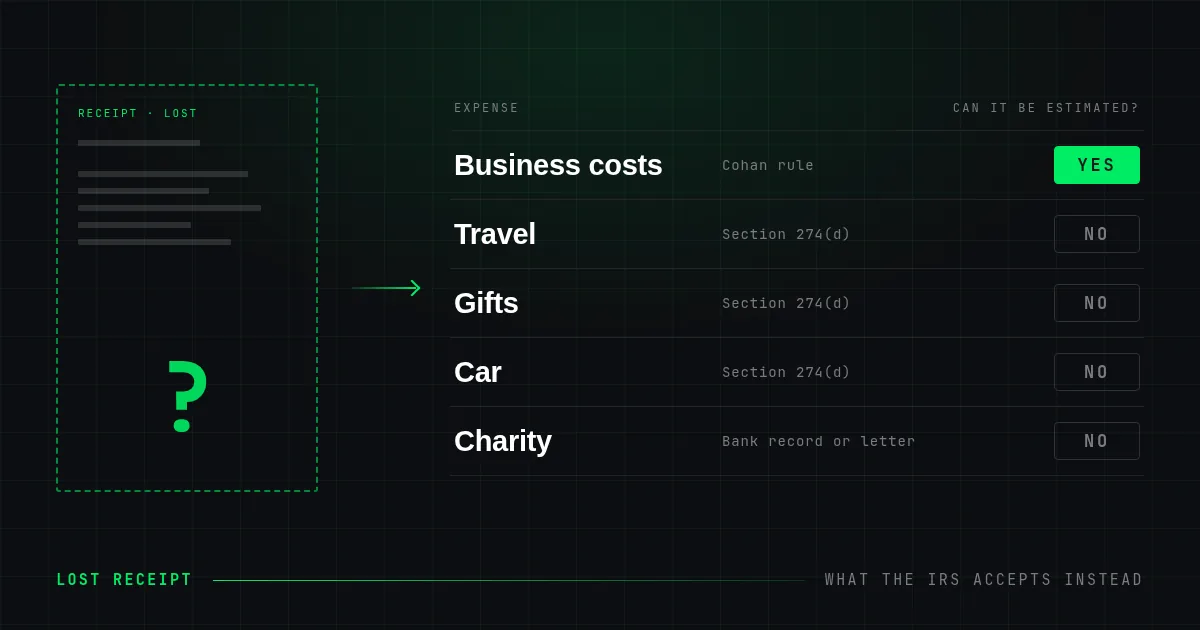
There are limits. For travel, gifts, car expenses and donations to charity, the law asks for specific records, and an estimate won't do.
We read the IRS publications, the tax code and the regulation themselves, on 11 October 2026. Every rule below is quoted from the source that sets it, not from a tax blog's summary of it.
This article is general information about US federal tax, not tax, legal or accounting advice. It doesn't cover state taxes. If the IRS has written to you, or the amounts are large, talk to an enrolled agent, a CPA or a tax attorney before you reply.
The short version
- A lost receipt is not a lost deduction. IRS Publication 463 says missing records can be made up with "your own written or oral statement" and "other supporting evidence".
- A bank statement proves you paid, not what you paid for. Publication 583 puts it this way: "Proof of payment of an amount, by itself, does not establish you are entitled to a tax deduction."
- Most business expenses can be estimated when the proof runs short. That's the Cohan rule, from a 1930 court decision. Expect the estimate to be low.
- Travel, gift and car expenses can't be estimated. Section 274(d) of the tax code asks for proof of the amount, the time and place, and the business purpose.
- Donations to charity need paper, whatever the amount. A bank record or a note from the charity for any cash gift, and a written acknowledgment for $250 or more.
- Records destroyed by fire or flood get their own allowance. You may rebuild them by what the regulation calls "reasonable reconstruction".
- Never fill the gap with a receipt you made yourself. Handing the IRS a document you know to be false is a crime, and the civil fraud penalty is 75%.
Do you need receipts to file your taxes?
Not to file. A tax return doesn't travel with its receipts. They matter at one moment: when the IRS asks you to back up a number on the return.
The IRS calls this the burden of proof. "The responsibility to prove entries, deductions, and statements made on your tax returns is known as the burden of proof," it says, and "you generally must have documentary evidence, such as receipts, canceled checks, or bills, to support your expenses."
How often does the IRS ask? Rarely. The IRS Data Book for 2025 counts 157,951,815 individual income tax returns filed for tax year 2019. By 30 September 2025 the IRS had examined 0.3% of them, about three in every thousand.
The rate depends on income. It was 0.2% for returns between $25,000 and $200,000, and 11.5% for returns showing total positive income of $10 million or more.
Share of individual tax returns the IRS examined, by income
Percentage of returns filed for tax year 2019 that were examined, by total positive income
- All individual returns0.3%
- No positive income5.6%
- $1 to $25,0000.4%
- $25,000 to $50,0000.2%
- $50,000 to $75,0000.2%
- $75,000 to $100,0000.2%
- $100,000 to $200,0000.2%
- $200,000 to $500,0000.3%
- $500,000 to $1 million0.8%
- $1 million to $5 million1.8%
- $5 million to $10 million3.4%
- $10 million or more11.5%
The same table holds a less comfortable number, and this one is our own arithmetic. Of the 504,465 examinations of 2019 individual returns that the IRS had closed, 57,449 ended with no change. That's 11%. The other 89% ended with the tax bill changed.
| Individual returns for tax year 2019 | Figure |
|---|---|
| Returns filed | 157,951,815 |
| Examinations closed by 30 September 2025 | 504,465 |
| Share of returns examined | 0.3% |
| Closed examinations that ended with no change | 57,449 |
| No-change share of closed examinations | 11% |
So the odds of being asked are small, and the odds of walking away untouched once you're asked are small too. That's the case for sorting out a missing receipt now, before a letter arrives.
How far back can the letter reach? "Generally, the IRS can include returns filed within the last three years in an audit," the IRS says. If it finds a substantial error it may add years, but "we usually don't go back more than the last six years." That's the reason behind the usual advice on how long to keep receipts.
What does the IRS accept when a receipt is lost?
The IRS accepts other evidence. That means your own written or oral statement about the expense, backed by something independent: a bank statement, an invoice, a duplicate from the seller, or a statement from someone who was there.
The rule is in chapter 5 of Publication 463, under the heading "What if I Have Incomplete Records?":
If you don't have complete records to prove an element of an expense, then you must prove the element with:
- Your own written or oral statement containing specific information about the element, and
- Other supporting evidence that is sufficient to establish the element.
Two parts, and you need both. Your account of what happened, with specifics. And something independent that supports it.
Publication 463 covers travel, gift and car expenses, which carry the strictest record-keeping rules in the tax code. If a statement plus supporting evidence can work there, it can work for a box of printer paper.
Here is what each kind of substitute shows, in the IRS's own words where it has them.
| Evidence | What the IRS says | What it proves |
|---|---|---|
| A duplicate from the seller | A document is adequate if it shows "the amount, date, place, and essential character of the expense" | Everything the original did |
| Bank or card statement | Acceptable proof of payment if it shows the amount, the payee's name and the date | That you paid, whom, and when |
| Cancelled cheque with the bill | "A canceled check, together with a bill from the payee, ordinarily establishes the cost" | The cost, but not a business purpose |
| Invoice, paid bill or order confirmation | "Documentary evidence can be receipts, paid bills, or similar evidence" | What you bought |
| Diary, log or calendar kept at the time | "A timely kept record has more value than a statement prepared later" | The date, the place and the purpose |
| Written statement from someone who was there | Counts as direct evidence of the cost, time, place or date | The detail your own statement needs backed |
| Your own statement, with nothing else | Must come with "other supporting evidence" | Nothing by itself |
| A receipt you made yourself | Not evidence | Nothing, and see below |
The second row deserves a closer look, because a statement is what most people have. Publication 583 says account statements can prove payment if they are "highly legible" and show three things. For a card payment, that's the amount charged, the payee's name and the transaction date. For a cheque, add the cheque number.
Then comes the limit: "Proof of payment of an amount, by itself, does not establish you are entitled to a tax deduction. You should also keep other documents, such as credit card sales slips and invoices, to show that you also incurred the cost."
In plain terms, a statement line reading OFFICE DEPOT $212.40 shows you paid a stationery shop. It doesn't show whether you bought toner for the business or a desk for your daughter. Pair it with the order email, or with a note you wrote at the time, and it becomes proof.
The IRS makes the same point about every record it asks for in an audit: "No record can stand on its own. You must include the circumstances surrounding any document you send."
Which deductions can be estimated, and which can't?
Ordinary business expenses can be estimated when the proof runs short. Travel, gift, car and charity deductions can't. The split comes from one court case and one section of the tax code, and most guides get it wrong in one direction or the other.
The Cohan rule: where an estimate is allowed
Cohan was a theatrical manager and producer. He told the Board of Tax Appeals he had spent $55,000 on travel and entertaining over two and a half years, and he had kept no record of any of it. The Board allowed him nothing.
On 3 March 1930 the Second Circuit Court of Appeals sent the case back. Judge Learned Hand wrote:
Absolute certainty in such matters is usually impossible and is not necessary; the Board should make as close an approximation as it can, bearing heavily if it chooses upon the taxpayer whose inexactitude is of his own making.
The Cohan rule is the principle that came out of that sentence. If the evidence shows you really did spend something on a deductible expense, a court may estimate the amount instead of allowing nothing.
Read the judge's sentence again, though, because it cuts both ways. There has to be "some basis for computation", in the court's words. A bare claim with nothing behind it isn't one.
And the estimate leans against you: "bearing heavily" on the person whose records are missing. An estimate under Cohan is a floor, not a refund of what you spent.
Where an estimate is not allowed
Congress later closed that door for the kinds of expense Cohan himself was claiming. Section 274(d) of the tax code covers travel, gifts, and listed property such as a car. For those, it says, "no deduction or credit shall be allowed" unless the taxpayer substantiates four things. Substantiate is the tax code's word for prove. The proof must come "by adequate records or by sufficient evidence corroborating the taxpayer's own statement":
- The amount of the expense
- The time and place of the travel, or the date and description of the gift
- The business purpose
- The business relationship of the person who benefited
The Treasury regulation names the case it overrules. "This limitation supersedes the doctrine found in Cohan v. Commissioner," it says, and no deduction is allowed "on the basis of such approximations or unsupported testimony of the taxpayer." Publication 463 says it in nine words: "You can't deduct amounts that you approximate or estimate."
Notice what section 274(d) still permits. It doesn't say receipt or nothing. It says adequate records, or your own statement with evidence that corroborates it.
So a lost airline receipt can still be replaced by the airline's reissued copy, or by a card statement plus the booking email and your calendar. What you can't do is say "about $900" and stop.
There's also a small-expense rule. Publication 463 says documentary evidence isn't needed where "your expense, other than lodging, is less than $75". You still have to record the amount, date, place and purpose. Lodging needs a document whatever it cost. An employer can set a lower limit for its own expense claims. That's a separate rulebook, and our guide to a lost receipt on an expense claim covers it.
Charity: the strictest of all
For a cash gift to charity, Publication 526 leaves no room: "You can't deduct a cash contribution, regardless of the amount, unless you keep one of the following." The list is a bank record, or a receipt or other written communication from the charity, showing its name, the date and the amount.
That makes a lost donation receipt one of the easier problems here. A bank or card statement showing the charity's name is a bank record, and it qualifies.
At $250 the rule tightens. "You can claim a deduction for a contribution of $250 or more only if you have a contemporaneous written acknowledgment of your contribution from the qualified organization", or certain payroll records. Contemporaneous has a deadline: you must have the letter by the day you file, or by the return's due date including extensions, whichever is earlier. If you've lost it, ask the charity for another before you file.
| Kind of expense | Can an estimate stand in? | What the rule asks for |
|---|---|---|
| Ordinary business costs: supplies, software, rent, fees | Yes, under the Cohan rule | Evidence that something was spent, and a basis for the figure |
| Travel away from home, with its meals and lodging | No | Amount, time, place and purpose, from records or a corroborated statement |
| Business gifts | No | The same, plus the date, a description and the business relationship |
| Car and other listed property | No | The same, usually a mileage log |
| Cash gifts to charity under $250 | No | A bank record or a written note from the charity |
| Gifts to charity of $250 or more | No | A written acknowledgment, in hand before you file |
What if your records were destroyed?
Then a separate rule helps you. Publication 463 says: "If you can't produce a receipt because of reasons beyond your control, you can prove a deduction by reconstructing your records or expenses. Reasons beyond your control include fire, flood, and other casualties."
The regulation goes further and calls it a right. Where records are lost "through circumstances beyond the taxpayer's control, such as destruction by fire, flood, earthquake, or other casualty, the taxpayer shall have a right to substantiate a deduction by reasonable reconstruction".
Every example in that rule is a disaster. Nothing we read says a receipt left in a taxi or faded in a glovebox counts as beyond your control, so don't plan on this route for ordinary loss. The incomplete-records rule above is the one that covers it.
For real disasters, the IRS publishes a guide to rebuilding records. Among its suggestions:
- Ask your bank or card company for past statements.
- Get copies of invoices from suppliers. They "should date back at least one calendar year".
- Look through your phone for photos that show what you owned.
How to rebuild your tax records, step by step
Start with the strongest evidence, which is also the easiest to get, and work down. Do it now, while you still remember the details.
- Ask the seller for a duplicate. A reissued receipt is a receipt. Shops, hotels and airlines can usually reprint one, and rental car companies keep them online for months. Our guide to what to do when you lose a receipt covers how to ask.
- Download the statements. Bank and card statements for the year, legible, showing the amount, the payee and the date.
- Find the itemised trail. Order confirmations, emailed invoices and your account history with the seller show what you bought, which a statement can't.
- Get the IRS's own copy of your records. The IRS says you can get transcripts with its Get Transcript tool or by calling 800-908-9946, and past returns with Form 4506.
- Write your own statement, with specifics. For each expense: the amount, the date, the place and the business purpose. Date the statement the day you write it. Don't backdate it.
- Ask someone who was there. A written statement from a client, colleague or supplier is direct evidence of the cost, time and place.
- Label everything as what it is. A reconstruction is honest when it says it's a reconstruction. And when you send anything to the IRS, its own advice is: "Never mail original records. Send us copies."
The fifth step is the one people skip. Publication 463 warns that a statement written later has less weight than one written at the time, "when there is generally a lack of accurate recall". So write it this week, not the week the letter comes.
What happens in an audit if you can't produce a receipt?
The examiner weighs whatever else you send, and then accepts the expense, allows part of it, or disallows it. There's less drama than people fear, at first.
The IRS says it will "provide you with a written request for the specific documents we want to see". An audit is run either by mail or in person. If you need longer, a mail audit can usually get "a one-time automatic 30-day extension".
You send what you have, organised by year and by type of expense. The examiner weighs it. For each item there are three possible results:
- Accepted. Your substitute evidence proves the expense.
- Partly accepted. The examiner allows a smaller figure. This is the Cohan rule at work, for the expenses it covers.
- Disallowed. The deduction comes off the return and the tax is refigured.
A disallowed deduction means more tax to pay. A penalty can be added on top. Section 6662 of the tax code adds 20% to the part of an underpayment that comes from negligence. It defines negligence to include "any failure to make a reasonable attempt to comply" with the tax law. Honest substitute records are how you show you made one.
The one thing not to do
Don't make a receipt and hand it over as the seller's.
It's tempting for a simple reason. The expense was real, and all you want is for the paperwork to match. But the law treats the document and the expense as separate questions.
- The fraud penalty. Under section 6663, if any part of an underpayment is due to fraud, the penalty is "75 percent of the portion of the underpayment which is attributable to fraud". The ordinary penalty is 20%.
- The crime. Section 7207 covers anyone who wilfully gives the IRS a document "known by him to be fraudulent or to be false as to any material matter". The punishment is a fine of up to $10,000, a year in prison, or both.
- The return itself. Section 7206 makes it a felony to sign a return you don't believe "to be true and correct as to every material matter".
And you don't need it. Everything above exists so that a lost receipt never forces that choice. The IRS's own route for incomplete records starts with your statement, labelled as yours. Made-up paperwork is also a known pattern: our expense fraud statistics report covers how often it turns up at work.
We make receipt templates, so we'll say plainly where they fit. A copy you rebuild for your own files is a note to yourself, in a tidy format. It belongs in your budget or your ledger.
It is not evidence, and our terms prohibit using one to support a tax deduction. If the IRS asks, send the statement, the duplicate and your written account. Never the copy.
What if you pay tax in the UK or Australia?
The same idea holds there, with less ceremony: replace what you can, estimate the rest, and say that you've done so.
United Kingdom. HMRC's guidance on lost or destroyed records says: "Try to get copies of as much as you can, for example ask banks for copies of statements or suppliers for duplicate invoices." Where that fails, "you can use 'provisional' or 'estimated' figures if you cannot recreate all your records", and you must say so on the return. HMRC adds a warning: "You may have to pay interest and penalties if your figures turn out to be wrong and you have not paid enough tax."
Australia. The Australian Taxation Office says that if your records "have been lost or destroyed, we can still accept the claim if it's not reasonably possible to get the original or replacement documents."
How we checked
We read each rule in the document that sets it, on 11 October 2026:
- IRS Publications 463 and 526, in their 2025 editions
- IRS Publication 583, as revised in December 2024
- The IRS pages on audits, records requests and the burden of proof
- Sections 274, 6662, 6663, 7206 and 7207 of the Internal Revenue Code
- Treasury Regulation 1.274-5T
Every sentence in quotation marks above is copied from one of them.
The Cohan quotation comes from the court's opinion as published by Harvard's Caselaw Access Project, not from a summary of it.
The audit figures are from Table 3-1 of the IRS Data Book for 2025. The 0.3% and the rates by income are the IRS's own figures. The 11% is ours: 57,449 no-change examinations divided by 504,465 closed ones.
We used tax year 2019 because the IRS warns that no-change rates for recent years look higher until more examinations close. The same sum gives 14% for 2020 and 13% for 2021.
What we could not verify
- How generous a Cohan estimate is in practice. We read the 1930 decision and the regulation that limits it. We didn't survey later Tax Court cases, so we can't say how much a court typically allows.
- Whether ordinary loss counts as "beyond your control". The rule's examples are all disasters. We found no IRS text that settles it either way.
- How your examiner will weigh your evidence. The publications say what counts. They don't say how much of it is enough.
- State tax rules. Everything here is federal.
- Audit rates for recent years. The IRS marks tax years 2022 and 2023 as still inside the normal three-year window, and its rates for those years will rise.
- What "changed" means in the 89%. The Data Book counts examinations with no change to the tax owed. It doesn't split the rest into bills and refunds.
- Canada and other countries. We read UK and Australian guidance only.
Common questions
What should I do if I lost my receipts for taxes?
Rebuild the evidence before anyone asks for it. Ask each seller for a duplicate. Download the bank and card statements for the year. Find the order emails and invoices that show what you bought. Then write a dated statement for each expense, giving the amount, the date, the place and the purpose. The IRS accepts your statement together with supporting evidence in place of a receipt.
Can I claim a tax deduction without a receipt?
Often, yes. The IRS says that if your records are incomplete, you can prove an expense with your own written or oral statement plus other supporting evidence. A bank statement, an invoice or a witness all count. Two limits apply. Travel, gift and car expenses can't be estimated, and a cash donation needs a bank record or a note from the charity.
Does the IRS accept bank statements instead of receipts?
As proof of payment, yes. Publication 583 accepts a legible statement that shows the amount, the payee's name and the date. But it adds that proof of payment "by itself, does not establish you are entitled to a tax deduction." You also need something showing what the payment was for.
What is the Cohan rule?
The Cohan rule lets a court estimate a deductible expense when the taxpayer can show that money was spent but can't prove the exact amount. It comes from Cohan v. Commissioner, decided by the Second Circuit in 1930. It doesn't apply to travel, gifts or car expenses, which section 274(d) of the tax code took out of its reach.
Do I need receipts for expenses under $75?
Not for most travel and transport expenses. Publication 463 says documentary evidence isn't needed if the expense, "other than lodging, is less than $75". You still have to record the amount, the date, the place and the business purpose. Lodging needs documentary evidence at any amount.
What if I lost the receipt for a charitable donation?
Use your bank or card statement. For a cash gift, Publication 526 accepts a bank record showing the charity's name, the date and the amount. For a gift of $250 or more you need the charity's written acknowledgment, and you must have it before you file. Ask the charity to send another.
How far back can the IRS ask for receipts?
Usually three years. The IRS says it can generally include returns filed within the last three years in an audit, and that it usually doesn't go back more than six. Our guide to how long to keep receipts has the full table.
Can I recreate a lost receipt for the IRS?
You can reconstruct your records, and the IRS's own publications use that word. What you can't do is present something you made as the seller's original. Send the IRS your statements, any duplicate the seller gives you, and a written account that says plainly it was prepared afterwards.
Corrections and updates
Sources last read on 11 October 2026. No corrections have been made since.
Tax rules and IRS publications are revised every year. If something here is out of date, tell us and we'll update it and give the new date.
Sources
Read on 11 October 2026 unless a different date is given.
- Internal Revenue Service: Publication 463 (2025), Travel, Gift, and Car Expenses, chapter 5, Recordkeeping
- Internal Revenue Service: Publication 583, Starting a Business and Keeping Records, revised December 2024, for account statements as proof of payment
- Internal Revenue Service: Publication 526 (2025), Charitable Contributions, Substantiation Requirements
- Internal Revenue Service: Burden of proof, reviewed 1 October 2026
- Internal Revenue Service: IRS audits, reviewed 17 February 2026, and Records we might request
- Internal Revenue Service: Reconstructing records after a natural disaster or casualty loss, reviewed 29 July 2026
- Internal Revenue Service: Data Book 2025, Table 3-1, examination coverage by tax year, with examinations closed as of 30 September 2025
- Internal Revenue Code: section 274(d), section 6662, section 6663, section 7206 and section 7207, as published by Cornell's Legal Information Institute
- Treasury Regulation 1.274-5T, paragraphs (a)(1) and (c)(5)
- Cohan v. Commissioner, 39 F.2d 540 (2d Cir. 1930), Harvard Law School Caselaw Access Project
- GOV.UK: Keeping your pay and tax records
- Australian Taxation Office: Replacing lost or damaged tax records, updated 8 October 2026