Lost receipt for an expense claim: what to do
You lost a receipt and the claim is due. What finance teams accept — merchant duplicates, thresholds, statements, declarations — and the one thing not to do.
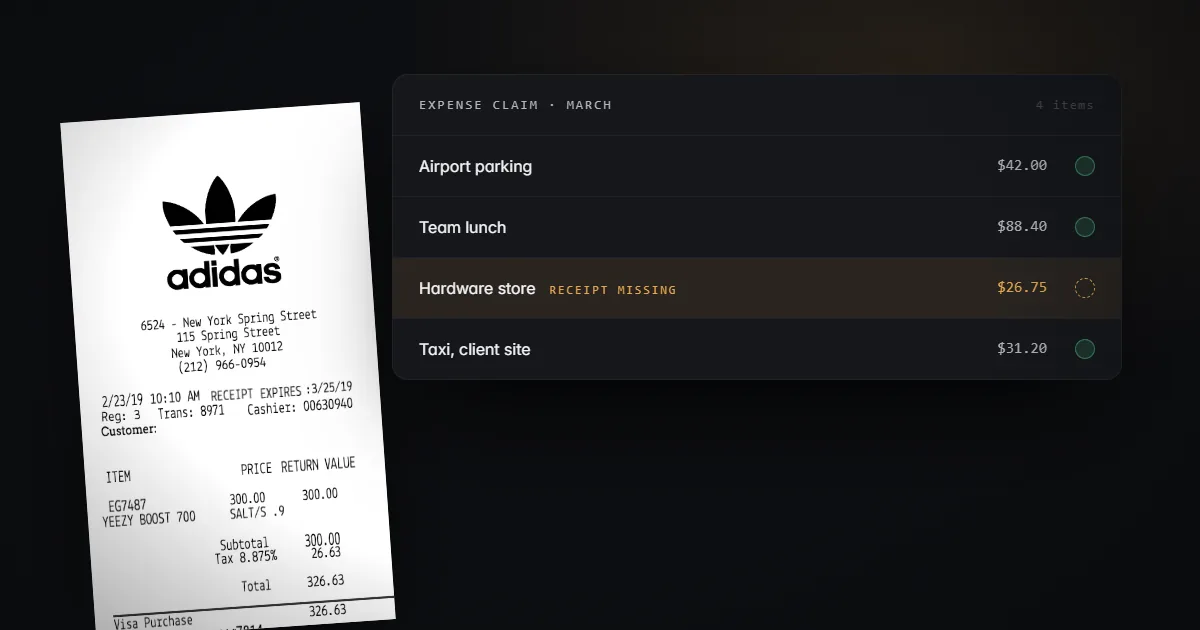
The claim is due, the receipt is gone, and the expense was real. This is an ordinary situation with an ordinary process — finance teams deal with it constantly and there's a recognised route through.
General information, not tax, legal or accounting advice. Your employer's policy may be stricter than the law, and rules differ by country. Check your actual expense policy, and ask your finance team — they would far rather answer a question than unpick a problem.
Start with the merchant duplicate
Before filing anything, spend five minutes trying to get the original back. It's the outcome your finance team prefers and it removes the problem entirely.
If you paid by card, the merchant can almost certainly find the transaction from the date, approximate amount and last four digits. Chains often have it in an app. Hotels and airlines can nearly always reissue a folio or itinerary — worth knowing, because lodging is the category where a receipt is most likely to be mandatory. Online orders have a permanent invoice in your account.
A reissued duplicate is the original for these purposes. Everything below is what to do when that fails.
Know your two thresholds
There are two separate limits and people conflate them.
The tax threshold
For US federal purposes, IRS Publication 463 generally does not require documentary evidence for travel, gift and car expenses under $75 — with the significant exception that lodging always requires a receipt, whatever it cost. You still have to record the amount, date, place and business purpose; the relief is from keeping paper, not from keeping records.
Your employer's threshold
Entirely separate, and usually stricter. Many companies set an internal limit — $25 is common — under which a described expense line is accepted without a receipt. Some require receipts for everything. This is company policy, not law, so read the policy.
The threshold that binds you is whichever is lower:
| Set by | Typical limit | Lodging | |
|---|---|---|---|
| Tax threshold | IRS Publication 463 | Under $75 | Receipt always required |
| Employer threshold | Your company's expense policy | Often $25, sometimes $0 | Per policy |
A $40 taxi may be fine for the IRS and still need a receipt for your employer.
Will my employer accept a bank statement instead?
A statement line establishes that you paid a specific merchant a specific amount on a specific date. For a modest, unambiguous expense — a taxi, a coffee for a client — that's often enough on its own.
It fails when composition matters. A statement doesn't show what you bought, so it can't distinguish the reimbursable half of a bill from the personal half. A $180 restaurant line could be a client dinner or a family one. A $95 hardware line could be split three ways across projects. Where only part of the spend is eligible, or the category drives the tax treatment, or VAT is being reclaimed, the statement alone will usually be rejected.
Reinforce it with anything contemporaneous: the booking confirmation, the calendar entry showing who attended, the order email, a photo you took at the time. A statement plus a calendar entry naming three clients is a much stronger submission than a statement alone.
File the missing receipt declaration
Most organisations have a form for this — missing receipt affidavit, lost receipt form, expense declaration. If yours does, use it. It's the designed path, and using it marks the claim as a known category rather than an anomaly.
What it generally asks for:
- Merchant, date and amount
- What was purchased, itemised as well as you can manage
- Business purpose, and who was present if relevant
- Why the receipt isn't available
- Your signature attesting the account is accurate
Write the itemisation properly. "Dinner — $180" invites a query; "Dinner for 4 (client names), Ristorante X, 12 Aug — food $146, service $34" usually doesn't. The declaration is doing the work the receipt would have done, so it should carry comparable detail.
If there's no formal form, send the same information in an email to whoever approves your expenses and ask them to confirm it's acceptable. Get the acceptance in writing.
The thing you must not do
Do not create a replacement receipt and submit it as though it came from the merchant.
It's tempting precisely because the expense was genuine — you're not trying to take money you aren't owed, you just want the paperwork to match. But the two things are separate. Fabricating a document that a person will rely on as authentic is fraud in most jurisdictions regardless of whether the underlying purchase was real. That the money was genuinely spent is not a defence to having manufactured the evidence.
In practice it also tends to fail. Finance teams see thousands of receipts, and reconstructions rarely carry the details a real one does — the register number, the terminal ID, the authorisation code, the exact tax rounding. Expense platforms increasingly check images automatically. And a fabricated receipt turns a routine missing-paperwork question into a disciplinary matter.
Our terms prohibit this explicitly: you may not use our tool to submit a false expense to an employer or client, or to support a claim someone will act on. We are saying the same thing here that we say there.
The declaration route exists so nobody has to make that choice. It is the correct answer, it is unremarkable to a finance team, and it works.
Where rebuilding a receipt does belong
Once the claim is settled honestly, rebuilding a copy for your own records is a different act entirely. If you keep a personal ledger, track spending, or need a legible line where a faded slip used to be, reconstructing it for your own filing is just record-keeping — the same as writing it into a spreadsheet, in a format that matches the rest of your folder.
That's what our templates are for. The distinction is simply whether anyone else is meant to treat it as the original. For your filing: fine. For submission: no.