How long should you keep receipts?
Tax records, warranties, returns and insurance run on different clocks. How long to keep each, what to digitise, and why thermal paper fades first.
There isn't one answer, because a receipt can be four different documents at once: tax substantiation, proof of purchase for a warranty, evidence for a return, and support for an insurance claim. Each has its own clock, and the one that governs is whichever runs longest.
General information, not tax, legal or accounting advice. Retention rules vary by country and by circumstance. Confirm your own position with a qualified professional.
How long should you keep tax records?
Three years in the ordinary case, and seven if you want one rule that covers almost everything. The detail matters, though, because two situations run longer and one runs forever.
For US federal purposes the IRS works from a period of limitations — the window during which a return can be amended or additional tax assessed. Its own guidance on how long to keep records sets out the common cases:
| Situation | Keep for |
|---|---|
| Ordinary return, nothing unusual | 3 years from filing (or the due date, whichever is later) |
| Income under-reported by more than 25% | 6 years |
| Claim for a loss from worthless securities or bad debt deduction | 7 years |
| Return filed late, not filed, or fraudulent | Indefinitely |
| Employment tax records | 4 years from when the tax was due or paid |
Three years covers most people. The practical advice most accountants give is seven, because it covers the 6-year case without your having to judge in advance whether you're in it.
Assets are different
For anything you'll later sell — property, investments, a business asset — keep the purchase records for as long as you own it plus the limitation period afterwards, because the purchase price determines the gain. A receipt for a kitchen renovation can matter decades later when the house is sold. That's not a 3-year document.
Outside the US
The shape is similar with different numbers: the UK generally expects 22 months after the tax year for individuals and 6 years for companies; Australia says 5 years; Canada, 6. Check your own jurisdiction.
Warranties and guarantees
Keep the receipt for the length of the warranty, plus a few months.
The receipt establishes the purchase date, which is what starts the clock. A 2-year warranty on a washing machine means a 2-year receipt, minimum. Extended warranties and consumer-protection regimes can run considerably longer — some jurisdictions give statutory rights well beyond the manufacturer's term, based on what's reasonable for the product.
For anything with a long expected life — appliances, tools, electronics, furniture — file the receipt with the manual and keep both until the item goes. It's a small filing cost against the chance of a large repair bill.
Returns and exchanges
Short: 30 to 90 days covers most retail policies.
The exception is anything you're unsure about keeping. If there's a plausible chance you'll return it, the receipt lives in the box until you've decided.
Insurance
Keep receipts for insured items for as long as you own them.
This is the category people neglect and regret. After a fire, flood or burglary, an insurer will ask you to substantiate what you owned and what it was worth. A list assembled from memory afterwards is worth much less than contemporaneous receipts for the expensive items. Jewellery, electronics, bicycles, instruments, tools — file those receipts permanently, and keep the file somewhere that won't burn with the house.
Business records
Beyond tax, business receipts support your accounts, and company law usually sets its own retention period — commonly 6 to 7 years. If you're VAT or GST registered, the input tax you reclaim needs supporting documentation for the period your tax authority specifies.
If you have employees or contractors, expense documentation may also be caught by employment record rules, which can run longer than tax.
The problem with the paper
Almost all of this assumes the receipt is still readable. Frequently it isn't.
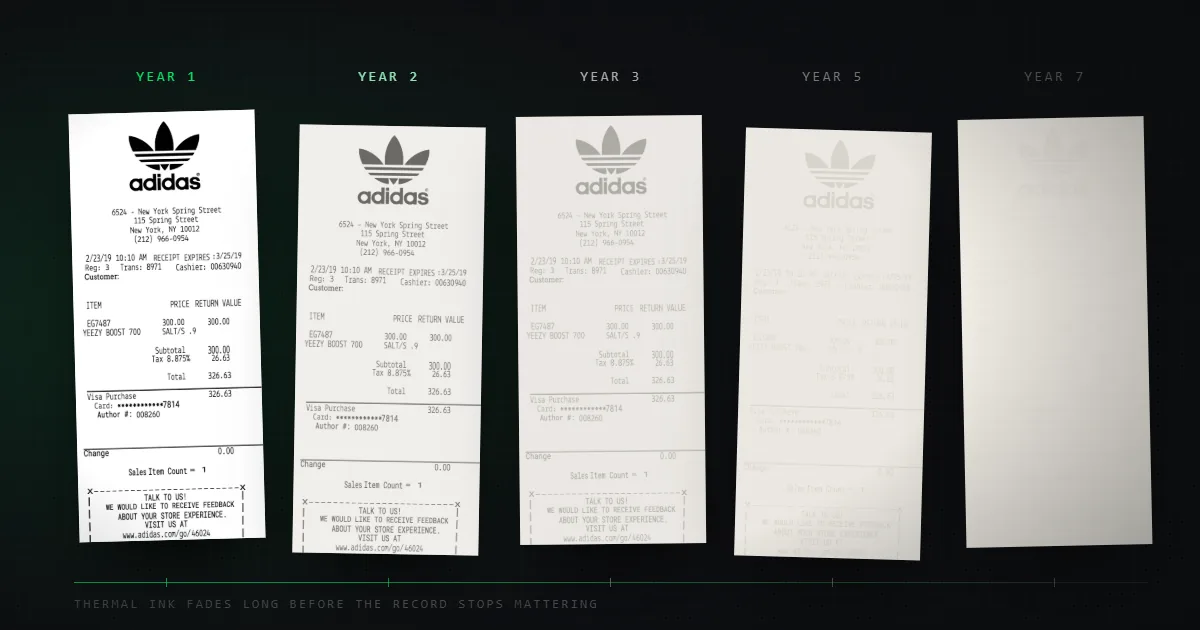
Thermal receipts — which is most of them — are printed by heating paper, not by depositing ink. The image fades. In a cool dark drawer a thermal receipt might last a few years. In a wallet, a car, or anywhere warm or bright, it can be illegible in months. Contact with certain plastics accelerates it, which is why a receipt stored in a PVC wallet can be worse off than one loose in a folder.
So a 7-year retention requirement and a thermal receipt are not compatible. The paper will very often fail first.
Digitise anything that matters, promptly. A photograph taken at the point of purchase is the actual record; the paper is a temporary carrier. For tax and insurance purposes, most authorities accept legible digital copies — the IRS has accepted scanned records for many years — provided they're complete and retrievable. Check your own jurisdiction's rules, but the general direction is that a clear scan is as good as the paper, and considerably more likely to still exist.
A workable habit:
- Photograph at purchase for anything above a threshold you set.
- File monthly into folders by tax year.
- Keep insured-item receipts permanently, separately, and off-site or in the cloud.
- Bin the paper once the scan is filed, except where an original is specifically required.
A quick reference
| Kind of receipt | Keep for |
|---|---|
| Everyday tax-deductible expense | 3 years (7 to be safe) |
| Asset purchase (property, investments) | Ownership + limitation period |
| Warranty item | Warranty term + a margin |
| Retail return | 30–90 days |
| Insured valuables | As long as you own it |
| Business records | 6–7 years, per local rules |
If the receipt is already gone
Fading and loss are the same problem from your filing's point of view. If you're missing something you needed, what to do when you lose a receipt walks through recovering it — and where rebuilding a copy for your own records does and doesn't belong.