How to keep a mileage log the IRS will accept
What a mileage log must show, from the IRS regulation itself: four details per trip, yearly miles, weekly entries allowed, no per-trip odometer. Free template.
It's December, you're self-employed, and you think you drove about 9,000 miles for work this year. Schedule C is going to ask you two questions about them: "Do you have evidence to support your deduction?" and "If 'Yes,' is the evidence written?" A mileage log is how you answer yes to both.
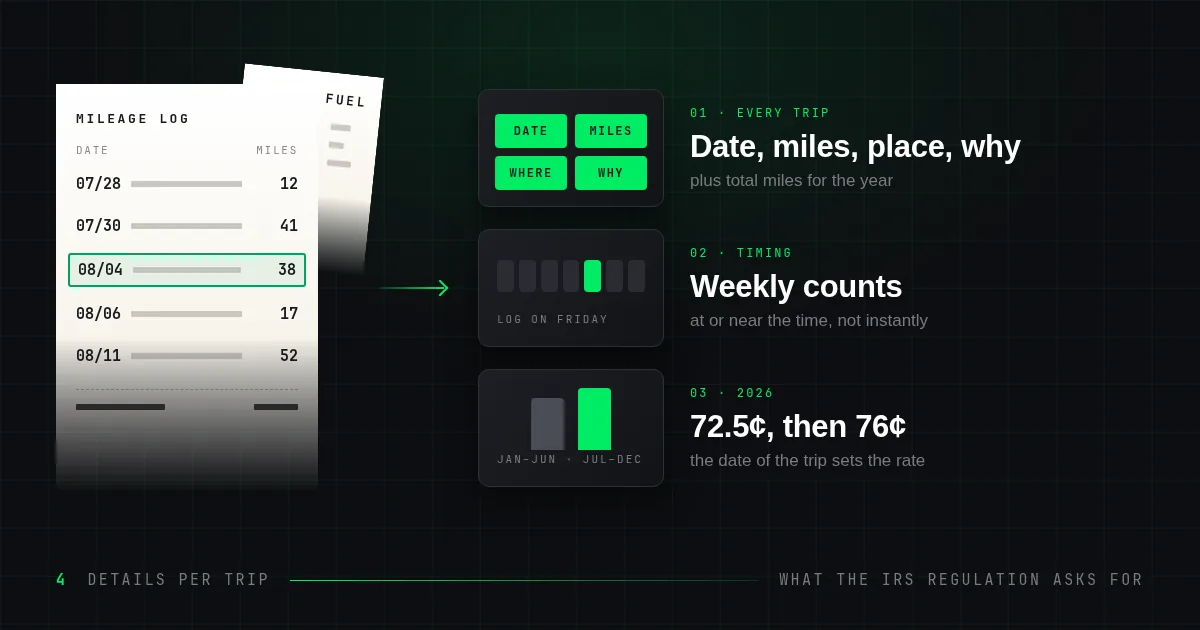
A mileage log is a written record of each business trip: the date, the miles, where you went and why. Add your total miles for the year and you have what the IRS asks for. It doesn't have to be an app, and it doesn't have to be filled in the moment you park. A notebook or a spreadsheet works, and the regulation accepts a log you update once a week.
We read the federal rules on 17 November 2026: the Treasury regulation that sets the standard (26 CFR 1.274-5T), IRS Publication 463 and the current Schedule C. Every requirement below is quoted or taken from those, not from the mileage-app vendors that fill most search results. Where the rules leave room, we say so.
This article is general information, not tax or legal advice. Ask a tax professional about your own return.
The short version
- Record four things for every business trip: the date, the business miles, the destination and the business purpose.
- Record your total miles for the year, business and personal. Reading the odometer on 1 January and 31 December is the simplest way.
- Write it down at or near the time. The regulation says outright: "A contemporaneous log is not required." A log kept weekly counts.
- Any format works. Paper, a spreadsheet or an app. The regulation accepts a record kept "in a computer memory device with the aid of a logging program."
- Odometer readings for every trip are optional. The IRS's own sample log has columns for them, but the rule asks for the miles, not the readings.
- In 2026 the date also sets the rate. Business miles are worth 72.5 cents to 30 June and 76 cents from 1 July, so undated totals cost you money.
- The totals go on Schedule C, lines 44a to 44c: business, commuting and other miles, which together make up the year's total.
- Keep it for at least three years after you file. Longer if you're depreciating the car.
What does a mileage log have to show?
For each business use of the car, the log has to show how far, when, where and why. The regulation lists these as amount, time, place and business purpose, in 26 CFR 1.274-5T(b)(6). Publication 463 turns them into a table. This is what it says for car expenses:
| Element | What to record | IRS wording, Publication 463, Table 5-1 |
|---|---|---|
| Amount | Miles for each trip, and total miles for the year | "the mileage for each business use, and the total miles for the year" |
| Time | The date you drove | "the date of the use of the car" |
| Place | Where you drove to | "Your business destination." |
| Business purpose | Why the trip was for work | "Business purpose for the expense." |
The "total miles for the year" line catches people out. The regulation asks for each business use "and the total use of the listed property for the taxable period." That's every mile on the car, not only the work ones, because your business share is worked out from it. A log that lists 9,000 business miles and nothing else doesn't show what share of the car's use they were.
The purpose doesn't need to be an essay. "Site visit, Hendricks kitchen" or "Pick up tile order 2214" is enough to show it was work. Publication 463 says that if the business purpose "is clear from the surrounding circumstances, then you don't need to give a written explanation."
If you claim parking fees and tolls on top of the mileage rate, keep those receipts too. Each one is a separate expense with its own amount and date. If one goes missing, see what to do when you lose a receipt.
Do you need odometer readings for every trip?
No. This is where the app vendors' guides disagree with each other, and the regulation settles it. It asks for "the amount of each business/investment use," measured in "mileage for automobiles," and the total use for the year. It says miles. It doesn't say how you measure them.
The confusion comes from the IRS's own example. Publication 463 prints a sample "Daily Business Mileage and Expense Log" with start and stop odometer columns. It is labelled "THIS IS NOT AN OFFICIAL INTERNAL REVENUE FORM." It shows one way to keep a log, not the only way.
So a trip's miles can come from the odometer, a trip meter, a map route or an app's GPS track. What you do need is a reliable total for the year. In our view, the simplest way to get one is to note the odometer reading on 1 January and 31 December, or on the days the car started and stopped being used for business. Two numbers a year will hold up better than a guess.
What does a filled-in week look like?
Here's a made-up week for a self-employed kitchen fitter in August 2026, kept with odometer readings. The readings are optional, but they show something useful: the gaps between one trip's end and the next trip's start are personal miles, which count towards the year's total.
| Date | From and to | Business purpose | Odometer start | Odometer end | Miles |
|---|---|---|---|---|---|
| Mon 3 Aug | Workshop to Hendricks house and back | Site visit, Hendricks kitchen | 41,102 | 41,140 | 38 |
| Tue 4 Aug | Workshop to Bay Street showroom | Collect worktop samples | 41,151 | 41,163 | 12 |
| Wed 5 Aug | Workshop to tile supplier, Route 9, and back | Pick up tile order 2214 | 41,190 | 41,231 | 41 |
| Thu 6 Aug | No business driving | 0 | |||
| Fri 7 Aug | Workshop to Nguyen house, Patel house and back | Two quotes, one round trip | 41,262 | 41,314 | 52 |
That's 143 business miles for the week. Between the first reading, 41,102, and the last, 41,314, the car covered 212 miles, so 69 were personal. At the 76 cent rate that applies from 1 July 2026, the 143 miles are worth $108.68. Friday's two stops are one entry, because Publication 463 lets a round trip with several business stops count as a single use.
How soon do you have to write it down?
Soon enough that you still remember it clearly. The regulation's phrase is "at or near the time," and paragraph (c)(2)(ii)(A) defines that as a time when you have "full present knowledge" of the trip.
It's more relaxed than most guides suggest. Paragraph (c)(1) says: "A contemporaneous log is not required." Paragraph (c)(2)(ii)(A) gives an example of what counts: "a log maintained on a weekly basis, which accounts for use during the week, shall be considered a record made at or near the time of such use."
The trade-off is credibility. Paragraph (c)(1) also says a record made at or near the time "has a high degree of credibility not present with respect to a statement prepared subsequent thereto when generally there is a lack of accurate recall." A log written each Friday is fine. A log written next April from memory is the thing an examiner is trained to doubt.
Paper, spreadsheet or app: does the format matter?
No. Paragraph (c)(2)(i) names "an account book, diary, log, statement of expense, trip sheet, or similar record." Paragraph (c)(2)(ii)(C)(2) accepts a car record kept with "a logging program," and Publication 463 adds: "if you prepare a record on a computer, it is considered an adequate record."
What matters is that each entry was made at or near the time. Each format has its own weak spot:
| Format | Strength | Weak spot |
|---|---|---|
| Notebook in the car | Nothing to forget to switch on | Gets lost, and the totals are added by hand |
| Spreadsheet | Totals and the 2026 rate split are automatic | Easy to fill in weeks later, which shows in the file history |
| GPS app | Records the miles and dates for you | Logs every drive, so you still have to mark which were work and why |
You can download our mileage log template, a plain CSV file that opens in Excel, Google Sheets or Numbers. It has one column for each element above, optional odometer columns, a rate column for the 2026 split and a row for the year's odometer readings. Delete the example row before you use it.
Can you keep a log for only part of the year?
Yes, if that part is typical of the rest. The regulation allows it in paragraph (c)(3)(ii)(A), and Publication 463 calls it sampling: "You can keep an adequate record for parts of a tax year and use that record to prove the amount of business or investment use for the entire year."
The catch is the next sentence: "You must demonstrate by other evidence that the periods for which an adequate record is kept are representative of the use throughout the tax year." The IRS's example is someone who logs the first week of every month, finds 75% business use, and backs it up with invoices and bills showing the work carried on at the same pace. That's 12 logged weeks out of 52. On a car driven 14,000 miles in the year, a 75% share supports 10,500 business miles.
Sampling suits a steady pattern. If your work driving changes with the seasons, or one big contract took you on the road for three months, a sample won't represent the year and a full log is safer.
Shortcuts the rules allow
A fixed route. If you drive the same sales or delivery route, you don't need to describe every trip. You can satisfy the rule "by recording the length of the delivery route once, the date of each trip at or near the time of the trips, and the total miles you drove the car during the tax year," says Publication 463.
Several stops in one trip. A round trip with several business stops can be one entry. Publication 463 says a lunch stop on the way doesn't break it: "Minimal personal use, such as a stop for lunch on the way between two business stops, isn't an interruption of business use."
Confidential details. If the place or purpose is confidential, you don't have to put it in the log itself. You do have to record it somewhere else at or near the time and be able to produce it.
What doesn't count as business mileage?
Commuting. Publication 463 is blunt: "You can't deduct commuting expenses no matter how far your home is from your regular place of work." It adds that taking a business call or carrying a colleague doesn't change that. Parking at your regular workplace is commuting too.
Driving from your regular workplace to a client and back is business. So is driving between two work sites. If your home is your principal place of business, you can deduct trips between your home office and other work locations; see Publication 463, chapter 4, before you count trips from home.
Why the date matters more in 2026
Because there are two rates. The IRS business rate is 72.5 cents a mile for miles driven from 1 January to 30 June 2026 and 76 cents for miles from 1 July. The IRS raised it mid-year because of fuel prices, as our IRS mileage rate report sets out.
A dated log lets you claim each mile at its own rate. On 10,000 business miles split evenly across the year, that's $7,425 instead of $7,250. With only a yearly total, you have no record of how many miles fell in each half, so the safe claim is the lower rate on all of them.
The split also means the season you drive in changes the total. For 10,000 business miles in 2026:
| When the miles were driven | Deduction at 2026 rates |
|---|---|
| All from 1 January to 30 June (72.5¢) | $7,250 |
| Half before 1 July, half after | $7,425 |
| All from 1 July to 31 December (76¢) | $7,600 |
The medical rate changed on the same date, from 20.5 to 23.5 cents. The charity rate stayed at 14 cents.
Where do the log's totals go on your tax return?
If you're self-employed and claim car expenses on line 9 of Schedule C, the log feeds Part IV, "Information on Your Vehicle." You complete it when you don't have to file Form 4562 for the business. The 2026 form asks:
| Line | What it asks | Where the answer comes from |
|---|---|---|
| 43 | The date the vehicle was placed in service for business | Your purchase or first-business-use record |
| 44a | Business miles | The log's yearly business total |
| 44b | Commuting miles | Home to regular workplace trips |
| 44c | Other miles | Everything else: total miles less 44a and 44b |
| 45 | Was the vehicle available for personal use off duty? | Yes or no |
| 46 | Do you or your spouse have another vehicle for personal use? | Yes or no |
| 47a | "Do you have evidence to support your deduction?" | Yes, if you have the log |
| 47b | "If 'Yes,' is the evidence written?" | Yes, for a written or app log |
Line 44 is introduced with "Of the total number of miles you drove your vehicle during 2026," which is why the yearly total matters. Lines 44a, 44b and 44c have to add up to it.
A worked example, using our own figures. The odometer read 31,850 on 1 January 2026 and 46,050 on 31 December, so the car covered 14,200 miles. The log shows 9,000 business miles, 4,100 of them before 1 July and 4,900 after. Commuting was 1,200 miles, which leaves 4,000 other miles.
| Miles | Rate | Amount | |
|---|---|---|---|
| Business, 1 Jan to 30 Jun | 4,100 | 72.5¢ | $2,972.50 |
| Business, 1 Jul to 31 Dec | 4,900 | 76¢ | $3,724.00 |
| Line 44a, business | 9,000 | $6,696.50 | |
| Line 44b, commuting | 1,200 | ||
| Line 44c, other | 4,000 | ||
| Total for the year | 14,200 |
Business use is 63.4% of the car's miles. Parking and tolls go on top of the $6,696.50. Claiming all 9,000 miles at 72.5 cents would have given $6,525, or $171.50 less.
If you file Form 4562 instead, for example because you depreciate the car, the same numbers go in Part V, Section B: line 30 for business miles, line 31 for commuting, line 32 for other personal miles and line 33 for the total. Line 24a asks "Do you have evidence to support the business/investment use claimed?" and line 24b whether it's written.
If your employer reimburses your mileage
Give your employer the log, or whatever record their expense system asks for. Under an accountable plan, a mileage allowance at or below the IRS rate isn't taxed as wages, provided you account for the trips.
Publication 463 says employees who hand their records to their employer and are reimbursed "generally don't have to keep copies of this information." There are exceptions. Keep your own copy if you claim more than you were paid, if the plan is nonaccountable, or if you're related to your employer. If a parking or toll receipt for the claim is lost, see lost receipt for an expense claim.
Most employees can't deduct unreimbursed mileage at all in 2026. The deduction for unreimbursed employee travel is now permanently disallowed, with exceptions for groups such as armed forces reservists and eligible educators.
What if you didn't keep a log?
Then you're in a weaker position, but not necessarily a hopeless one. Paragraph (c)(1) asks you to back up each trip "by adequate records or by sufficient evidence corroborating his own statement." A log made at or near the time is an adequate record. A statement you put together later needs evidence behind it.
That evidence usually exists. Your calendar shows the meetings. Invoices and job sheets show which clients you served on which days. Fuel and toll receipts, parking apps and phone location history show where the car was. Built from those, a record of past trips is evidence. Built from memory, it's an estimate.
There is also a narrow rule for records you kept and then lost. Publication 463 says that if you can't produce a receipt "because of reasons beyond your control," you can prove a deduction "by reconstructing your records or expenses." It gives fire, flood and other casualties as examples.
From here on, start a log today. A partial year of real records beats a full year of reconstruction.
When not to backfill a mileage log
We make receipt templates, and people sometimes ask whether a log can be "rebuilt" the same way. Here's where the line is.
Rebuilding from evidence is fine. Making entries up is not. A list of trips worked out from your calendar and invoices is a record of what happened. Trips added because the total looks too low are invented deductions.
Say what it is. A log you rebuilt in December is not a log kept at the time, and you shouldn't present it as one. If you're asked, explain how you built it and show the evidence. The regulation itself treats a later statement differently from a timely record. Pretending otherwise turns a weaker claim into a false one.
Don't backdate a file. Spreadsheets and apps keep edit histories. A "weekly" log whose entries were all created on the same day says so.
How long to keep your mileage log
At least three years from the date you file the return that claims the mileage. Publication 463 says records supporting a deduction are generally kept "for 3 years from the date you file the income tax return on which the deduction is claimed." A return filed early counts as filed on the due date. So for a 2026 return due on 15 April 2027, keep the 2026 log until at least 15 April 2030, even if you file in February.
If you depreciate the car rather than using the standard rate, keep the business-use records "for each year of the recovery period." For how long to keep receipts and other records, see our guide on how long to keep receipts.
How we checked
We read the federal rules on 17 November 2026: the substantiation regulation, 26 CFR 1.274-5T, as published on eCFR; IRS Publication 463 (2025), chapter 5, on recordkeeping; the 2026 Schedule C, Part IV; Form 4562, Part V; and the IRS announcements that set the 2026 mileage rates. Every quotation above was checked word for word against our saved copies of those pages.
We also read the top search results for "mileage log IRS requirements" on the same day. Nearly all came from companies selling mileage-tracking apps, and they disagreed on whether every trip needs odometer readings and how soon entries must be made. Those two questions are answered here from the regulation's own text.
What we could not verify
- How examiners treat each format in practice. The rules accept paper, spreadsheets and apps alike. We haven't seen audit data showing whether one fares better.
- Court decisions on reconstructed logs. Tax Court cases on mileage logs are common, but we didn't review them for this guide, so we haven't summarized how judges weigh a rebuilt log.
- The 2026 edition of Publication 463. We used the 2025 edition, the latest published when we checked. The regulation we quote is the current eCFR text, which Publication 463 follows.
- State rules. Some states follow the federal rules for mileage and some don't. This guide covers federal income tax only.
Common questions
What does the IRS require in a mileage log?
For each business trip: the date, the miles, the destination and the business purpose. You also need the total miles driven in the year for any purpose. Publication 463, Table 5-1, lists these for car expenses. The record should be made at or near the time, and a weekly log counts.
Do I need odometer readings in my mileage log?
Not for every trip. The regulation asks for the mileage of each business use and the total use for the year, not the odometer readings. The IRS's sample log has odometer columns but is marked as not an official form. Readings at the start and end of the year are the simplest way to get your total.
Can I use an app for my mileage log?
Yes. The regulation says a record kept "in a computer memory device with the aid of a logging program" is an adequate record. An app still needs you to mark which trips were business and why. A GPS track shows where you went, not the purpose.
Is there an official IRS mileage log form?
No. Publication 463 prints a sample "Daily Business Mileage and Expense Log," marked "THIS IS NOT AN OFFICIAL INTERNAL REVENUE FORM." Any notebook, spreadsheet or app that records the four elements and the yearly total meets the rule. Our free CSV template follows the IRS sample's columns.
How often do I have to update a mileage log?
Often enough that you still remember the details. The regulation requires entries "at or near the time" of the trip and gives a weekly log as an example that qualifies. It also says plainly that a contemporaneous log is not required. Entries made months later carry much less weight.
What happens if I don't have a mileage log?
You can still support the deduction with other evidence, such as your calendar, invoices and fuel receipts, but it carries less weight than a log kept at the time. If records were destroyed by something beyond your control, such as a fire or flood, Publication 463 allows a reconstruction.
Where do mileage log totals go on Schedule C?
In Part IV, "Information on Your Vehicle." Line 44a takes business miles, 44b commuting miles and 44c other miles, which together make up the year's total. Lines 47a and 47b ask whether you have evidence and whether it's written. If you file Form 4562 instead, the same figures go on lines 30 to 33.
Does commuting count as business mileage?
No. Driving between your home and your regular workplace is commuting, and Publication 463 says it isn't deductible "no matter how far your home is from your regular place of work." Trips from your workplace to clients or between work sites are business.
Corrections and updates
Rules last read on 17 November 2026. No corrections have been made since.
If a rule here has changed, or the IRS publishes a new edition of Publication 463 that differs, tell us and we'll update it and give the new date.
Sources
Read on 17 November 2026.
- Electronic Code of Federal Regulations: 26 CFR 1.274-5T, Substantiation requirements, paragraphs (b)(6)(i)(B), (c)(1), (c)(2)(i), (c)(2)(ii)(A), (c)(2)(ii)(C)(1) and (2), (c)(3) and (c)(3)(ii)(A), for the elements of a business use, "at or near the time", the weekly-log example, fixed routes, computer records, other evidence and sampling
- Internal Revenue Service: Publication 463 (2025), Travel, Gift, and Car Expenses, chapter 4 for commuting and parking, chapter 5 for adequate records, Table 5-1, sampling, destroyed records, the sample mileage log (Table 5-2) and how long to keep records
- Internal Revenue Service: 2026 Schedule C (Form 1040), Part IV, lines 43 to 47b
- Internal Revenue Service: Form 4562, Depreciation and Amortization, Part V, lines 24a, 24b and 30 to 33
- Internal Revenue Service: Standard mileage rates, and Announcement 2026-11 in Internal Revenue Bulletin 2026-29, for the 72.5 and 76 cent business rates in 2026
- Internal Revenue Service: IRS sets 2026 business standard mileage rate at 72.5 cents per mile, up 2.5 cents, IR-2025-128, 29 December 2025, for the rules on unreimbursed employee travel